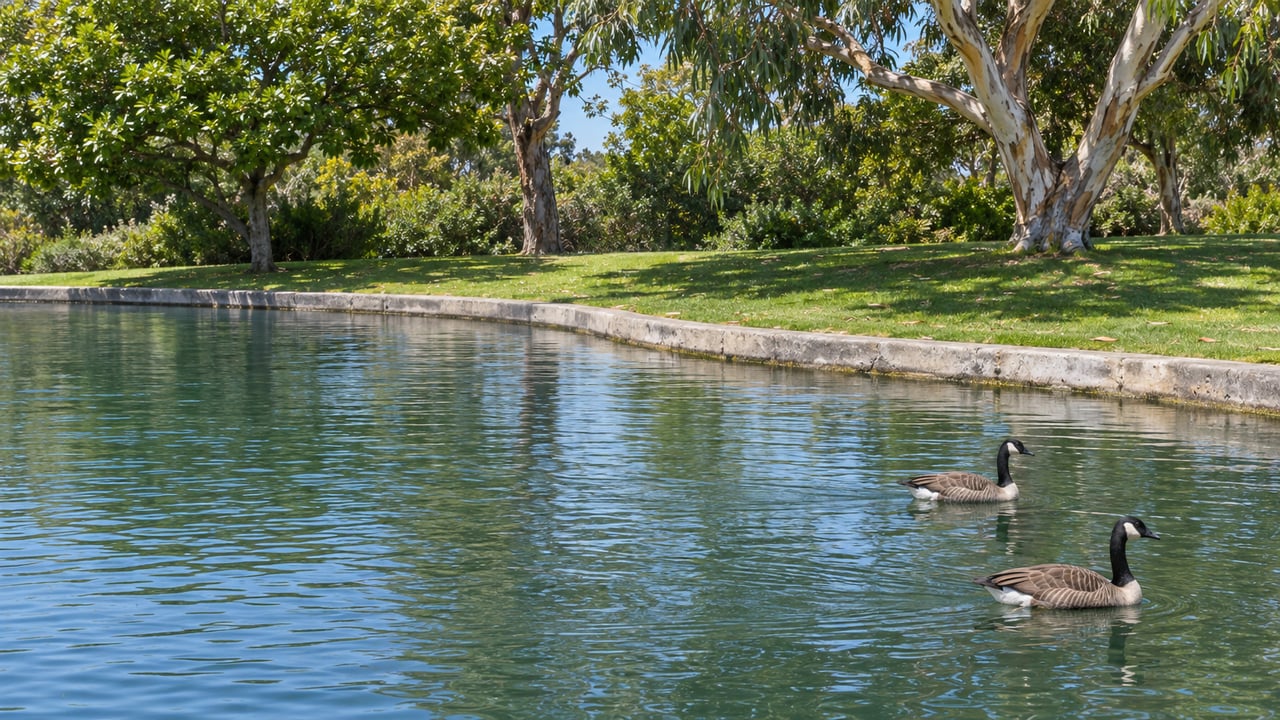
Polliwog Park's Geese Moved In for Good, and the City's New Plan Starts There
November 12, 2026
"Is that geese screaming at us?" Mayor Joe Franklin asked partway through the October 20 City Council meeting, according to Easy Reader's account of the session. "Geese are mean," Councilperson Amy Howorth answered.
The meeting ended with a 4–1 vote that changed how Manhattan Beach approaches the flock at Polliwog Park. After about two and a half years of studying the geese, the city's own staff told the council that cleanup and signs were not working. The geese at the pond are a local population that breeds there, and any plan that leaves breeding alone will keep failing.
Polliwog sits at 1601 Manhattan Beach Boulevard at Redondo Avenue. It covers 18 acres around a central pond, with three gazebos, a Rose Garden, an amphitheater, a lighthouse-inspired playground, a picnic area, and Begg Pool next door.
According to Easy Reader, Canada geese at Polliwog were seasonal visitors through the 1970s. They spent the winter and flew home when the weather warmed. At some point they stopped leaving. The park offers a pond they can retreat to, acres of irrigated turf to graze, and visitors who bring bread, and nothing in the area hunts them. Public Works Director Ramzi Awwad told the council the park is "a great place for geese, like it is for humans. They like being here."
Parks maintenance supervisor Chris O'Brien explained it this way: "This climate is very favorable. They don't have the extreme weather changes. They don't have a true apex predator in this area that would cause them to want to leave the area."
Biologist Robert Hamilton, whom the city hired in November 2024, gave the council figures from eBird, the database kept by birdwatchers.
| Measure | Count |
|---|---|
| Fall 2026 high counts at Polliwog | 60 to 80 geese |
| One-time fall spike | 134 geese |
| Typical spring counts | 20 to 40 geese |
| Resident population, staff estimate | 30 to 40 geese |
| Goslings observed in 2026 | 2 |
The gap between the fall and spring rows is what changes the problem. About 30 to 40 geese live at the pond all year, and the fall counts roughly double as other birds stop through. A goose eats about four pounds of grass a day and leaves about three pounds of droppings, so the daily total at the park works out to roughly 60 to 240 pounds, depending on the season.
Most of that mess lands in one place. O'Brien told the council the irrigated sports turf largely cleans itself because the sprinklers wash the droppings into the soil. The trouble is the hard surfaces around the pond, where the geese climb out of the water onto the concrete.
In September 2025, Hamilton gave the council a list of countermeasures. It included an anti-feeding campaign, a fence around the pond, green lasers, goose repellent on the sports fields, and addling eggs so they do not hatch. The council asked staff to price everything except egg addling.
When staff came back on October 20, Awwad said that while pricing those measures, "we came to find that selecting from some measures probably won't solve the problem and may be a waste of resources." O'Brien then laid out three options.
| Option | What it includes | Cost |
|---|---|---|
| 1. Status quo | Pressure washing the pondside sidewalks Tuesdays and Fridays, plus six bilingual no-feeding signs | About $35,000 a year |
| 2. More service | A third washing day and more public outreach | Another $25,000 |
| 3. Management plan | A multi-year, data-driven plan written by a specialist | $50,000 to write; $250,000 to $300,000 a year to carry out |
O'Brien summarized the first two options flatly: "One, we can keep doing what we're doing and expect the same outcomes. Two, increase the service levels, and we'll likely have the same outcomes." He said the cause the third option addresses is reproduction. "If they're going to raise their young there, they're going to continue to have success there. They're going to stay there."
Councilperson Nina Tarnay pointed out that one added day of washing would cost $25,000, nearly as much as the two existing days combined. Awwad said the extra day would exceed what Public Works crews can handle and would have to go to a contractor. Twice-weekly washing was already an increase from once a week, made after residents asked for more at an April 2025 community meeting.
Howorth asked why the flock had grown when the weather, the pond and the grass had always been there. O'Brien pointed to the missing predator, then stopped: "I won't allude to anything having to do with coyotes at this point."
The pause reflects a real conflict. Easy Reader reported that Manhattan Beach hired a coyote trapper in 2022 and amended its wildlife plan in 2023. At an earlier meeting, Hamilton had told the council that coyotes are the Canada goose's main natural predator, and that decoy coyotes don't work "unless there's some actual lethality." The animal the city has spent years removing is the one that would naturally keep the geese in check.
That leaves the city to do a predator's job itself. O'Brien said the specialist plan would likely include game-camera surveillance, hazing with lasers, acoustic devices and predator decoys, and changes to the pond's surroundings. He added that it may also bring back methods the council had passed over before: dogs chasing the geese, banding birds to track them, and egg addling. Franklin asked whether "canine hazing" meant police dogs. The answer was ordinary dogs.
Staff pointed to Foster City, a bayside city outside San Francisco, as a model. Hamilton had earlier described its program to the council: a $430,000 goose budget, a full-time biologist, border collies, helium balloons, floating decoys, and several kinds of drones, including one shaped like a peregrine falcon. "So maybe they will get rid of the geese," he said at the time, "but it's going to be at a real cost to the human experience." O'Brien told the council the firm the city has in mind helped carry out Foster City's plan.
Franklin doubted the fence would help. "Geese can fly, so they're going to fly over a fence," he said.
O'Brien's answer explained what the fence is for. Geese want a clear line of sight to the water. They rarely gather in the natural area behind the pond near Manhattan Beach Middle School because they cannot see what might come up behind them. A fence, railing or hedge around the pond could create that same blind spot. Hamilton added that it would at least keep the geese off the concrete they now hop onto from the pond. Tarnay noted that geese aren't the only animals using that concrete, and Hamilton said turtles have been climbing up there too.
Councilperson Steve Charelian wanted faster action. He asked for pressure washing four days a week and a temporary fence as soon as possible, calling Polliwog "the iconic location in East Manhattan Beach." Councilperson David Lesser called more washing "short-sighted." Franklin preferred trying volunteers and a few citations first, and he suggested service clubs and Scouts could talk with park visitors who bring bread.
Tarnay's motion combined parts of each position. It provides up to $25,000 more for pressure washing, $50,000 for the specialist plan, and cost estimates and renderings for a temporary fence before anything is built. "Otherwise, I think we're just kicking the poop can down the road for another day," she said. The motion passed 4–1, with Franklin voting no. The October 20 agenda listed the item as unbudgeted, so staff were directed to return with a budget request as part of the first-quarter budget update in November.
Even the plan's supporters don't expect the flock to disappear. Asked whether the city could ever reach zero geese, Hamilton said no.
Until the larger plan takes shape, here is what park users can expect:
Hamilton described the regional situation plainly: "Short of having a statewide or a national program, pretty much all you can do is try to keep them out of your area." Legg Lake in Whittier Narrows, he noted, has "hundreds and hundreds."
Questions about the park next door, what a pond fence would mean for your block, or anything else in East Manhattan Beach are a good reason to call. At Gauss Real Estate Group, we follow how council decisions like this one play out on the streets around Polliwog. Let's start the conversation today.
Stay up to date on the latest real estate trends.



Real estate is more than a transaction, it’s a journey. With a sharp eye for detail and a strategic approach, Alexandra Gauss ensures every move is smooth, smart, and successful. Let’s start the conversation today!