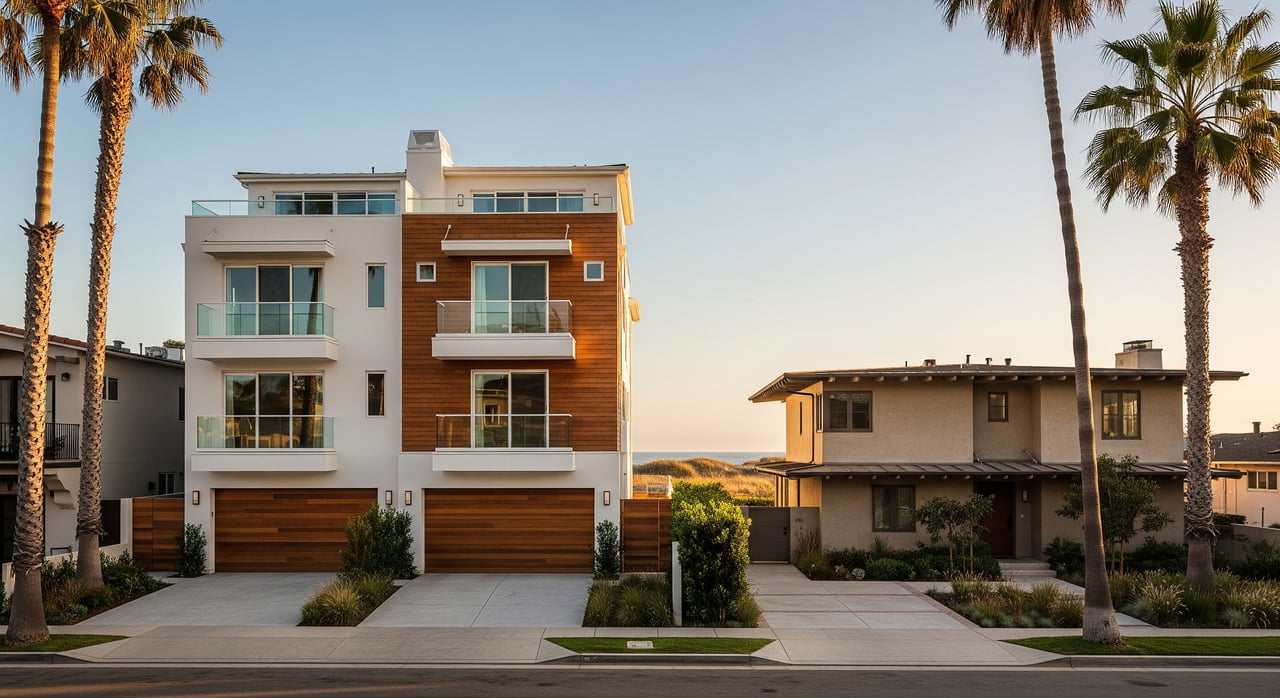
Manhattan Beach Townhome vs House: What Matters Most
January 1, 2026
January 1, 2026
Thinking about buying in Manhattan Beach and stuck between a townhome and a single-family house? You’re not alone. Both paths can get you close to the sand and the South Bay lifestyle, but the day-to-day experience and long-term costs are different. This guide breaks down what really matters here: total monthly budget, HOA rules, maintenance by the coast, privacy, parking, and resale dynamics across key Manhattan Beach sections. By the end, you’ll have a clear path to the right fit for your lifestyle and goals. Let’s dive in.
If you compare similar locations, single-family homes in Manhattan Beach usually carry a higher purchase price than attached townhomes. The premium reflects private lots, yard space, and the sheer scarcity of detached properties, especially in the Sand and Hill sections.
Your total monthly outlay is more than just principal and interest. In California, property taxes are based on Proposition 13 with a 1 percent base rate on assessed value plus local voter-approved assessments. Because detached homes tend to cost more, they often lead to higher absolute tax bills compared to townhomes.
Insurance also differs. Single-family owners insure the entire structure and lot. Townhome and condo communities usually have a master policy for building exteriors and common areas, while you carry an HO-6 policy for interiors and personal property. Coverage varies by community, so you need to verify exactly what the master policy covers and where your policy starts.
HOA dues are the biggest variable for attached properties. Dues can be modest in smaller buildings or higher in planned communities with amenities, building insurance, and robust reserves. The tradeoff is less surprise maintenance, but you’ll want to evaluate dues versus the maintenance you’d handle on a single-family home.
Quick budget check: Add mortgage, taxes, insurance, HOA dues, utilities, and routine maintenance for a true apples-to-apples monthly view.
With a townhome or condo, you become part of a homeowners association governed by the Davis-Stirling Common Interest Development Act. HOAs commonly manage exterior maintenance, landscaping, parking enforcement, trash, master insurance, and shared utilities or amenities.
Before you buy, review the CC&Rs, bylaws, and rules for use restrictions like pets, rentals, and exterior modifications. Study the budget, reserve study, financials, and meeting minutes to spot funding gaps, pending capital work, or recurring issues. Ask about pending litigation and any history of special assessments. Rental caps or minimum lease terms can also affect your options.
Bottom line: The HOA should feel well-run and well-funded. Strong reserves and clear policies reduce risk and support resale value.
Single-family homes give you full control over maintenance and upgrades, from roof to yard. That flexibility is a plus, but the costs and planning are on you. Roofs, foundations, fences, drainage, and landscaping all fall under your scope.
Townhomes and condos shift much of the exterior and shared-system maintenance to the HOA, funded through dues and reserves. In Manhattan Beach, salt air and coastal weather can accelerate wear on exterior materials, metal fixtures, and HVAC. A proactive HOA can smooth these costs and help keep buildings in shape.
If you consider a townhome, clarify whether it is a condominium or a fee-simple or PUD-style townhome. Ownership boundaries affect who pays for what, especially for exteriors, roofs, and land.
Single-family homes typically offer more privacy, no shared walls, and more control over outdoor space. You can use the yard, plan landscaping, and host with fewer shared-area considerations.
Townhomes share walls or sit closer to neighbors, and outdoor areas may be smaller or limited to decks and patios. Noise can be a factor in attached living, including foot traffic in common areas and shared parking.
Close to the beach in the Sand Section, both property types can experience higher ambient activity from pedestrians, events, and nightlife. The exact block and orientation matter. Walk a property at different times of day to understand the rhythm.
Detached homes usually provide a private garage and driveway, which makes day-to-day life easier in a popular coastal city. You also tend to get better storage options in garages, attics, or sheds, though lot sizes vary by section.
Townhomes often come with deeded garage spaces or assigned parking, but guest parking can be limited. Some buildings use tandem garages. Storage in attached communities may be tighter, so confirm dimensions and any storage lockers.
Manhattan Beach enforces residential parking rules near the beach, and street availability can fluctuate with visitor traffic. This is especially relevant in the Sand Section, where permit zones and time limits shape parking options.
Practical checks: Confirm deeded spaces, guest parking rules, EV charging permissions, and whether any garage or spaces are common area subject to HOA control.
In Manhattan Beach, detached lots are scarce, which can support long-term value for single-family homes. Buyers who want private yards and the potential to expand often focus on these properties, and teardowns or rebuilds in the Hill and Tree sections influence pricing and future potential.
Townhomes and condos attract a wide range of buyers who want lower-maintenance coastal living. Values generally track broader market strength but can be more sensitive to HOA health, project reputation, and lending dynamics. In attached communities, comparable sales within the same complex or block carry extra weight.
For renovations, single-family homes usually offer more flexibility for additions and major remodels, subject to permits and zoning. Attached properties often require HOA architectural approvals and face limitations on structural and exterior changes.
Financing for single-family homes is straightforward for most loan types. For condos and certain townhome communities, lenders may require project approvals and will review HOA financials, litigation, and delinquency rates. Fee-simple or PUD townhomes are often easier to finance than condos because they do not always need the same project-level approval.
Insurance coverage differs by ownership type. Detached owners carry full homeowners policies. Attached owners rely on the HOA’s master policy for the building exterior and common elements, then add an HO-6 policy for interiors and personal property. Confirm whether the master policy is all-in or bare-walls and ask about loss assessment coverage.
Appraisals for attached units can be sensitive to timing and the most recent sales in the same project. Give your lender time to review HOA documents and confirm loan eligibility, especially if you plan to use FHA or VA financing.
Manhattan Beach is a set of distinct sections, each with a different feel and pricing profile.
Coastal exposure brings additional considerations. Portions of the city fall within the Coastal Zone, and flood risk can vary. It is smart to check FEMA flood maps and city guidance in low-lying areas or near storm drains. Insurance availability and cost can be influenced by these factors.
School attendance boundaries within Manhattan Beach Unified School District can influence demand and resale for both property types. If school access is a priority, confirm the current boundaries for a specific address.
Local rules may affect short-term rentals and occupancy. If rental income or vacation use is part of your plan, review current city ordinances and your HOA’s rental policy. Some communities limit lease lengths or cap rental percentages.
Use this list to compare specific properties and avoid surprises.
Documents and disclosures
Physical inspections
Key questions to ask
Timing and financing
Choose a townhome if you want lower-maintenance coastal living, predictable HOA-managed exterior care, and a potentially lower total purchase price in a prime location. This can be a strong match if you value walkability and are comfortable with rules on rentals, pets, and exterior changes.
Choose a single-family home if you want privacy, control over renovations, and the flexibility that comes with owning a detached lot. In Manhattan Beach, land scarcity often supports long-term value, especially in sections where rebuild activity is common.
If you are torn between the two, run the full monthly number for a few properties in different sections. Then layer in lifestyle needs like parking, storage, outdoor space, and proximity to the beach. That usually reveals a clear answer.
Ready to compare specific addresses and HOAs or evaluate a property’s long-term potential? Connect with Gauss Real Estate Group (Alex Gauss) for local guidance and a process built for high-value South Bay decisions.
Stay up to date on the latest real estate trends.
Real estate is more than a transaction, it’s a journey. With a sharp eye for detail and a strategic approach, Alexandra Gauss ensures every move is smooth, smart, and successful. Let’s start the conversation today!